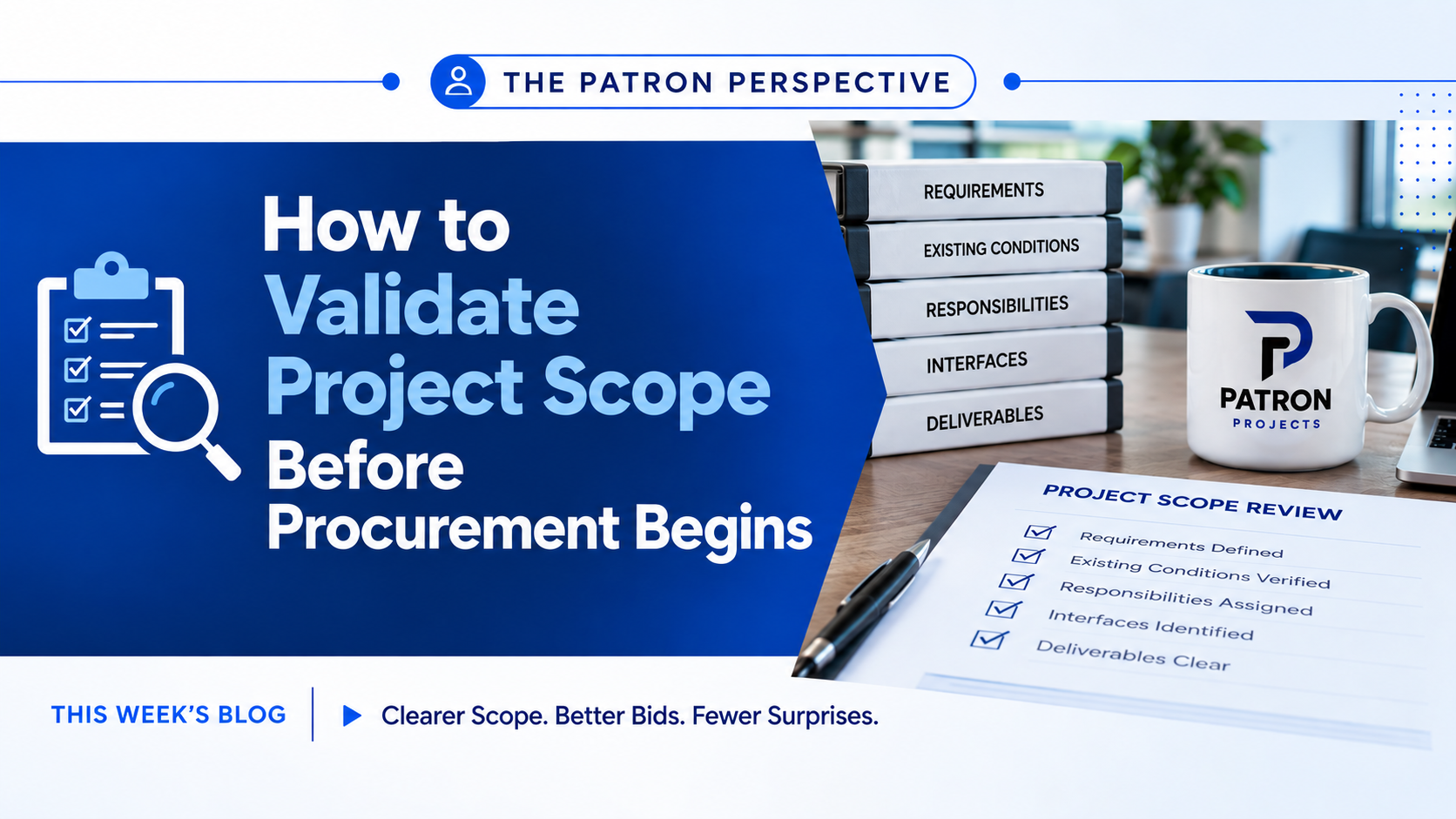
A project should not enter procurement until the organization can explain, in practical terms, what it expects to buy, what conditions the work must account for, and where responsibility begins and ends.
That sounds basic. It often is not.
Technology projects frequently reach procurement with a scope that is directionally correct but operationally incomplete. The major components are identified, budgets have been discussed, and stakeholders generally agree on the outcome. But assumptions remain unresolved. Existing conditions have not been sufficiently validated. Interfaces between disciplines are unclear. Requirements are understood differently by different groups.
Procurement does not fix those problems. It usually makes them more expensive.
Validate the Conditions Behind the Scope
A scope can be technically accurate and still be incomplete because it was developed around assumptions rather than verified conditions.
A network upgrade may identify the equipment being replaced without confirming telecommunications room readiness, available power, pathway capacity, cabling conditions, or dependencies on other building systems. A security project may define new devices without resolving mounting conditions, network requirements, electrical work, or responsibility for integration with existing systems.
Those details eventually have to be addressed. The only question is whether they are addressed before pricing or after work begins.
Scope validation should test the proposed work against the environment where it will actually be delivered. Drawings, inventories, standards, previous project documents, and stakeholder knowledge are useful inputs, but they should not automatically be treated as physical truth. Where existing conditions affect cost, constructability, sequencing, or responsibility, they need to be confirmed.
Resolve Ownership Before the Work Is Bid
Some of the most disruptive scope problems occur between disciplines rather than within them.
Technology may assume facilities is providing electrical work. Facilities may believe that requirement belongs to the technology contractor. The security team may expect network connectivity to be included. The network team may assume the security contractor is responsible for it. Everyone understands their own portion of the project, but nobody owns the space between them.
Those gaps create procurement ambiguity.
Before issuing a request for proposals or other procurement documents, responsibilities should be clear enough that bidders are pricing the same project. Owner-furnished equipment, contractor-furnished equipment, demolition, patching, pathways, cabling, power, programming, testing, documentation, commissioning, and system integration all need defined ownership where they apply.
The objective is not to create an unnecessarily complicated scope document. It is to eliminate reasonable opportunities for different interpretations.
Test the Scope From the Bidder’s Perspective
A useful scope review asks a simple question: Could two qualified firms read this document and reasonably arrive at materially different interpretations of the required work?
If the answer is yes, procurement is likely to expose the problem.
One bidder may include work that another excludes. One may recognize an infrastructure dependency that another assumes will be handled by the owner. The resulting price spread can look like a competitive bidding issue when the real problem is that the bidders are not pricing equivalent obligations.
This makes bid evaluation harder as well. A lower number is not necessarily a better number when it represents a narrower interpretation of the work.
Scope validation should therefore include more than a technical review. The project should be examined for exclusions, interfaces, assumptions, acceptance criteria, deliverables, sequencing requirements, and dependencies that could affect how a bidder develops its price.
Make Procurement the Next Step, Not the Discovery Phase
There will always be unknowns in complex projects. Scope validation is not an attempt to eliminate every uncertainty before procurement.
It is about identifying the uncertainties that should already be resolved.
If a condition can materially change cost, schedule, responsibility, or technical approach, leadership should understand it before vendors are asked to price the work. Remaining unknowns should be intentional and documented rather than discovered accidentally through bidder questions, change requests, or field conflicts.
That discipline also gives the institution better control over procurement. Bidders receive a clearer basis for pricing, proposal comparisons become more meaningful, and negotiations can focus on legitimate differences rather than reconstructing what the project was supposed to include.
The best time to find a scope problem is while it is still a scope problem.
Patron Projects helps institutions independently validate project scope, existing conditions, responsibilities, and execution requirements before procurement begins. Explore Our Solutions: Project Scope Definition and Pre-Execution Validation