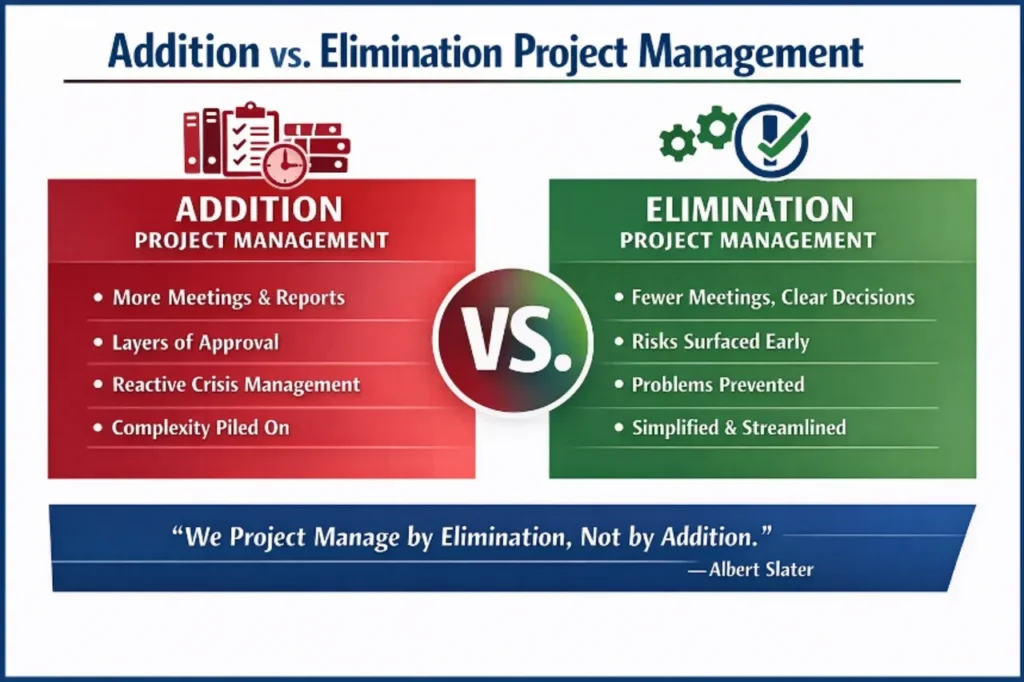
Project Management by Elimination, Not Addition

Most projects don’t fail because teams lack software, meetings, or process.


They fail because assumptions were never challenged, risks were never surfaced, and decisions were quietly deferred until the worst possible moment.


At Patron Projects, we work from a different premise:


“We project manage by elimination, not by addition.”

— Albert Slater


That isn’t a slogan. It’s how we run projects.

The Trouble With “Adding More”

When a project starts drifting, the instinct is predictable:


Add meetings.

Add reporting.

Add approvals.

Add contingency.


It feels responsible. It feels proactive.


But layering complexity on top of weak assumptions doesn’t create control. It hides problems until they’re expensive.


As Peter Drucker put it, “There is nothing so useless as doing efficiently that which should not be done at all.”


Running the wrong work efficiently is still the wrong work.

What We Eliminate

Elimination starts early.

We remove:


  • Assumptions that can be proven now
  • Risks that should be surfaced before construction or cutover
  • Scope that no one had the discipline to question
  • Decisions that are drifting without ownership
  • “Redundancy” that fails together in reality


Simplicity in complex environments isn’t accidental.

It’s the result of doing the hard thinking up front.

Why It Matters

In hospitals, universities, and public institutions, failure isn’t theoretical.


It affects:


  • Service continuity
  • Research and operations
  • Public trust
  • Safety


Reactive management asks,

“How do we respond when something breaks?”


Elimination-based leadership asks,

“Why is it still capable of breaking at all?”


That difference changes outcomes.

The Result

When you manage by elimination:


Projects grow quieter over time.

Decisions get clearer.

Go-lives feel uneventful.


And uneventful is exactly what you want.


That isn’t luck.

It’s discipline.


It’s why we project manage by elimination, not by addition.