| CORE MESSAGE: The implementation vendor delivers the contracted platform. The institution still owns the full migration outcome. Patron helps manage the work that falls between the two. |
Cloud-based voice platforms offer colleges and universities a valuable opportunity to modernize communications.
They can support remote and hybrid work, improve mobility, integrate voice with messaging and video, simplify administration, and reduce dependence on aging telephone infrastructure.
The platform may be simpler.
The migration usually is not.
A campus voice environment is much more than a collection of desk phones. It can include thousands of telephone numbers, departmental call flows, contact centers, emergency phones, elevators, alarms, paging systems, fax machines, analog devices, carrier services, shared lines, remote users, and decades of undocumented configuration.
Moving that environment to a modern Voice over Internet Protocol platform is not simply a technology replacement. It is an institution-wide program involving IT, networking, facilities, public safety, procurement, finance, department leaders, vendors, and hundreds—or thousands—of users.
Yet many institutions begin these projects with a dangerous assumption:
| DANGEROUS ASSUMPTION: The implementation vendor will manage the complete migration. |
In most cases, the vendor is responsible for delivering its contracted platform and professional services. The institution remains responsible for everything required to turn that implementation into a successful operational outcome.
That distinction is where many of the project’s most expensive risks begin.
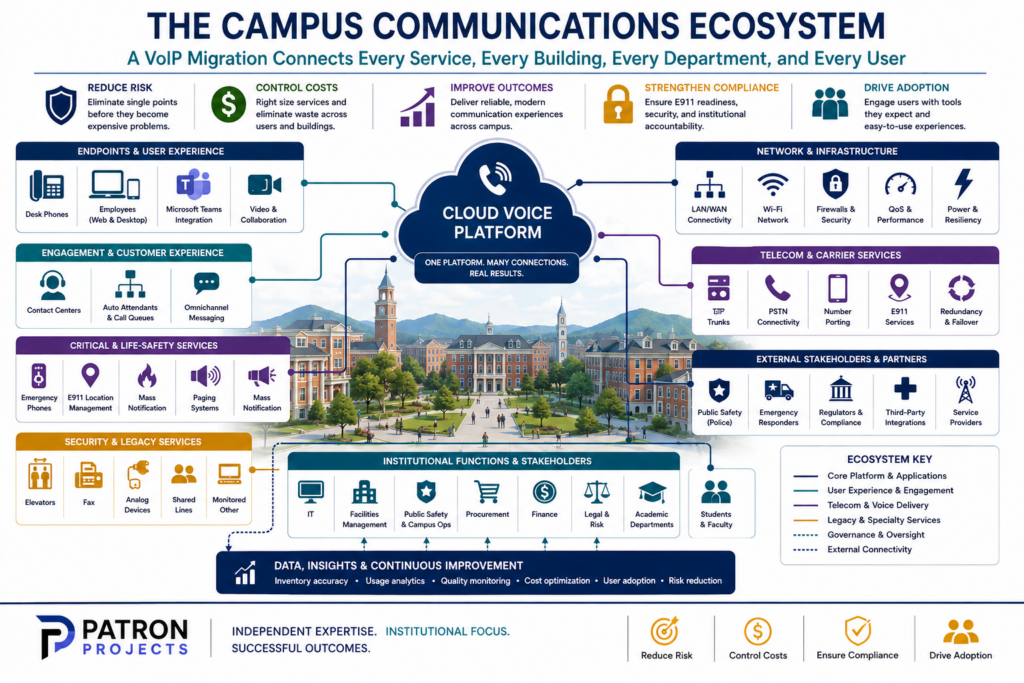
The campus communications ecosystem extends well beyond desk phones and the cloud voice platform.
The Hidden Work Behind a VoIP Migration
A cloud voice project may initially appear straightforward:
- Select the platform.
- Purchase the licenses.
- Configure the system.
- Port the telephone numbers.
- Train the users.
- Go live.
But those steps represent only the visible portion of the project.
Behind them are hundreds of decisions, dependencies, exceptions, and responsibilities that often fall outside the vendor’s direct scope.
Someone must determine what currently exists. Someone must validate which services are still needed. Someone must locate and assess analog devices. Someone must coordinate departments, facilities, public safety, carriers, network teams, implementation partners, and internal support groups.
Someone must also determine whether the institution is actually ready to migrate—not simply whether the vendor is ready to activate the platform.
| CORE MESSAGE: If no single party is responsible for coordinating the complete institutional outcome, critical work can fall between vendors, departments, and contracts. The platform may still be installed. The migration may still go live. But the institution can be left with service interruptions, unexpected costs, unresolved analog lines, confused users, extended legacy expenses, or responsibilities nobody realized they owned. |
Hidden Risk #1: The Institution May Not Know Everything It Has
One of the first major challenges in a campus VoIP migration is establishing an accurate picture of the current environment.
Most institutions have several different versions of their voice inventory:
- What institutional records say exists
- What is configured in the existing telephone system
- What carriers and service providers are billing
- What is physically installed and operating
Those four views frequently do not match.
A telephone number may still be assigned to an employee who left years ago. A carrier may continue billing for a circuit no department recognizes. A shared line may rely on programming that has not been reviewed in a decade.
An emergency phone, alarm panel, or fax line may be operating in a mechanical room, parking structure, rooftop enclosure, laboratory, elevator, or remote facility that does not appear in the central IT inventory.
These discrepancies are not just administrative inconveniences.
They can produce:
- delayed migration waves
- failed or incomplete cutovers
- emergency remediation
- unnecessary licenses
- continued carrier charges
- duplicated services
- unplanned vendor work
- extended operation of the legacy system
A spreadsheet from one department is not a validated migration baseline.
Reliable discovery requires institutional records, technical data, carrier billing, stakeholder input, and physical conditions to be reconciled. Unresolved items must have owners, decisions, and documented next steps.
The objective is not simply to create a better inventory.
It is to establish a trusted foundation for design, budgeting, procurement, migration planning, and eventual decommissioning.
Without that foundation, cost estimates become unreliable, schedules become speculative, and surprises appear when they are most expensive to resolve.
Hidden Risk #2: Analog and Life-Safety Services Are Easy to Miss
The most difficult part of many VoIP migrations is not the cloud platform.
It is everything the cloud platform leaves behind.
Analog services may support:
- elevator emergency phones
- blue-light phones and emergency call stations
- fire and intrusion alarms
- paging and intercom systems
- building-management systems
- parking gates
- utility equipment
- laboratory monitoring
- fax machines
- specialty devices
These services are often owned outside central IT. They may be billed under outdated descriptions, maintained by facilities contractors, documented in another department, or located in areas that are difficult to access.
Some are used every day.
Others may operate only during an emergency, inspection, or unusual event.
That makes them easy to overlook and dangerous to assume.
An undocumented fax line may be inconvenient.
An undocumented elevator or emergency line can become an operational, compliance, or public-safety concern.
Every analog service needs a deliberate future-state decision. It may need to be migrated, converted, replaced, temporarily retained, or disconnected with the appropriate approvals.
That decision can depend on device compatibility, local power, network availability, survivability, cabling, regulations, maintenance arrangements, and the operational importance of the service.
This is why analog discovery should be managed as a dedicated workstream—not treated as cleanup after the primary user migration has already begun.
Hidden Risk #3: The Vendor Is Not Responsible for Everything
VoIP platform providers and implementation partners bring essential technical knowledge.
They understand their products, configuration methods, licensing, integrations, number-porting processes, and deployment tools.
Their professional services may include:
- platform configuration
- identity integration
- number-porting coordination
- administrator training
- contact-center configuration
- testing support
- cutover assistance
Those services are important.
The mistake is assuming that they include every activity required for institutional success.
The institution may still be responsible for:
- validating users and telephone numbers
- locating analog devices
- documenting departmental call flows
- coordinating facilities and public safety
- preparing the data network
- obtaining internal approvals
- organizing user communications
- scheduling migration groups
- coordinating testing
- managing acceptance
- preparing operational support
- retiring legacy systems and carrier services
- training end users
- new telephone deployment
When those activities are not explicitly assigned and staffed, they do not disappear.
They become project gaps.
| CORE MESSAGE: ”VoIP Implementation must be project managed by elimination, not by addition.” |
This is especially risky when several vendors are involved. Multiple organizations may all claim to provide project management, discovery, testing, or migration support while actually managing very different portions of the work.
The platform vendor’s project manager may coordinate the platform vendor.
The carrier may coordinate number porting.
The network team may prepare infrastructure.
Facilities may manage building access and specialty systems.
Internal IT may manage users and operations.
| IMPORTANT DISTINCTION: Someone still needs to manage the integrated outcome across all of them. |
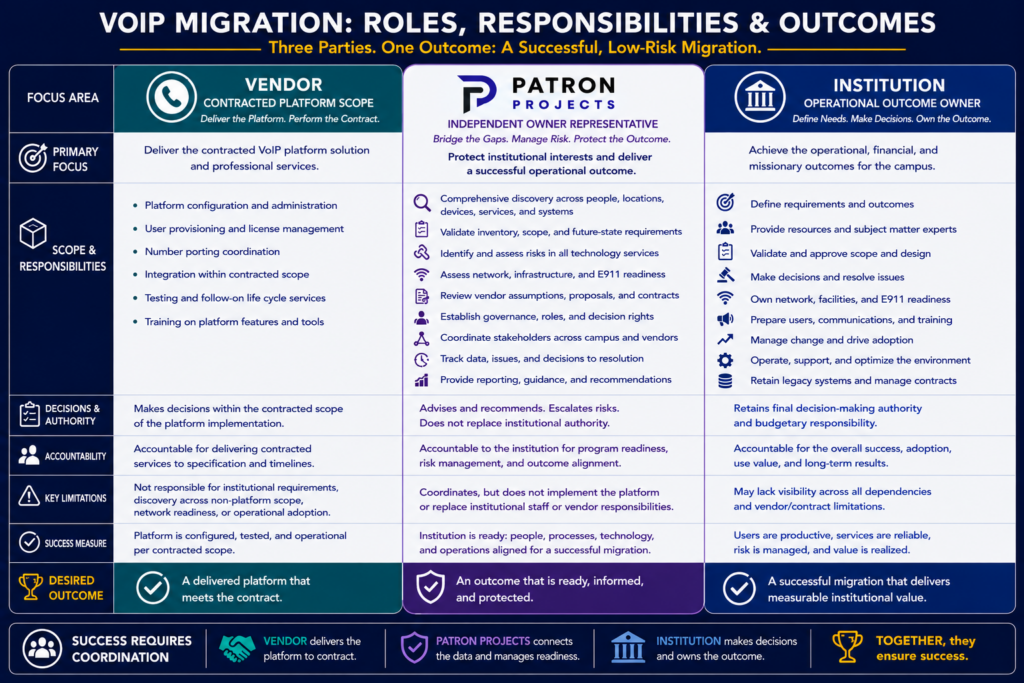
The vendor delivers scope, the institution owns the outcome, and Patron manages the gaps between them.
| IMPORTANT DISTINCTION: The vendor delivers its contracted solution. The institution owns the business and operational result. Patron helps manage the work between the two. |
Hidden Risk #4: Internal Teams May Not Have the Capacity
Most campus IT teams understand their environment better than any outside consultant.
The challenge is usually not capability.
It is capacity.
The same employees responsible for supporting daily operations may also be expected to:
- validate thousands of records
- attend discovery meetings
- coordinate vendors
- investigate analog services
- collect departmental requirements
- prepare communications
- manage migration schedules
- support testing
- train users
- resolve exceptions
- stabilize the new environment
All of this is added while they continue managing networks, systems, incidents, security issues, user requests, maintenance, and other institutional projects.
A large migration can require sustained attention for months or years. It may involve hundreds of decisions, multiple vendors, dozens of departments, and many separate migration waves.
Assigning the work to an existing project manager does not automatically solve the problem.
The project will require specialized understanding of telecom environments, analog services, vendor scopes, carrier dependencies, emergency calling, migration readiness, and legacy decommissioning.
It also requires someone with the time and authority to connect the workstreams, escalate unresolved issues, maintain accountability, and protect the institution’s interests.
Independent owner’s representation does not replace the internal team.
It gives the internal team dedicated support, structure, and coordination for a temporary but highly demanding program.
Hidden Risk #5: Small Scope Problems Can Become Expensive
The total cost of a VoIP migration includes much more than software licensing.
It may include:
- vendor professional services
- phones and headsets
- data network upgrades
- analog gateways
- cellular services
- cabling
- carrier charges
- integrations
- training
- temporary staffing
- support
- legacy-system maintenance
- overlapping services during transition
Poorly defined scope can produce duplicated work, unnecessary licenses, avoidable professional services, extended legacy costs, and change orders.
The best opportunity to control those costs often comes before implementation begins.
In one higher-education engagement, Patron reviewed proposed statements of work, professional-services activities, assumptions, exclusions, pricing, project-management functions, technical dependencies, and analog requirements.
The review identified overlapping services, unclear responsibility boundaries, and work that had quietly shifted back to the institution.
Real Client Result
| CHALLENGE: Multiple scopes included overlapping services, unclear assumptions, and responsibilities that were not fully aligned. |
| PATRON’S ROLE: Independently review the proposed delivery model, vendor responsibilities, project-management activities, dependencies, and costs. |
| The institution avoided more than $150,000 in proposed implementation costs before execution began. |
Go-Live Is Not the Same as Success
A project can reach its scheduled go-live date and still leave the institution with significant unfinished work.
Users may not understand the new platform. Departments may discover that call flows do not match operational needs. Analog services may remain unresolved. Support teams may not be prepared. Carrier billing may continue after services should have been disconnected.
Legacy systems may remain active because nobody has validated that they can be safely retired.
That is where projects can continue to consume money long after leadership believes the migration is complete.
A successful migration must also include:
- operational stabilization
- issue resolution
- user adoption
- support readiness
- billing validation
- documentation
- acceptance
- legacy decommissioning
- post-migration optimization
The final measure of success is not whether the cloud platform was activated.
It is whether the institution can operate confidently, support its users, control its costs, and retire what it no longer needs.
Where Patron Projects Fits
Patron Projects serves as an independent advisor, owner’s representative, and migration program-management partner.
We do not sell the cloud voice platform.
We represent the institution.
Our role is to connect the work that falls between vendors, departments, technical systems, contracts, and project phases.
Patron can support institutions at several points in the migration lifecycle.
Migration Readiness Assessment
We assess the current environment, available information, governance, internal capacity, dependencies, risks, and overall readiness.
The goal is to help the institution understand what it is walking into before commitments are made.
Vendor Proposal and Statement-of-Work Review
We independently review scope, pricing, assumptions, exclusions, responsibility boundaries, overlapping services, and potential change-order exposure.
The goal is to ensure that the institution understands what it is buying—and what it will still be expected to provide.
Migration Program Management
We coordinate vendors, departments, schedules, decisions, risks, communications, technical dependencies, testing, readiness, and implementation activities.
The goal is to maintain one integrated view of the complete institutional outcome.
Project Recovery and Risk Review
For migrations already experiencing delays, cost growth, unclear accountability, unresolved dependencies, or readiness concerns, Patron can provide an independent assessment and recovery plan.
The goal is to identify what is off track, establish priorities, and restore control.
Patron combines technical discovery, procurement analysis, owner advocacy, governance, and hands-on program management.
We do not stop after identifying risks or delivering recommendations.
We can remain engaged to manage decisions, coordinate participants, maintain accountability, and help carry the project through implementation, stabilization, and closeout.
Five Questions to Ask Before Moving Forward
Before signing an implementation agreement or committing to a migration schedule, leadership should be able to answer five questions:
- Can we reconcile our institutional records, telephone-system data, carrier billing, and physical devices?
- Does every analog and life-safety service have a validated migration or retirement plan?
- Do we know exactly what the vendor owns, what the institution owns, and who is managing the work between them?
- Has anyone independently reviewed the proposed scope, assumptions, exclusions, costs, and overlapping services?
- Is one party accountable for integrated readiness across all departments, vendors, and workstreams?
If the answer to any of these questions is unclear, the institution may be carrying more risk than leadership realizes.
Before You Finalize Your VoIP Migration
The greatest risk in a campus VoIP migration is not necessarily selecting the wrong platform.
| GREATEST RISK: It is assuming that the implementation vendor, internal team, and existing contracts collectively cover the complete work when no one is actually managing the complete institutional outcome. |
That gap can create operational disruption, unnecessary cost, delayed schedules, internal strain, and avoidable risk.
Patron helps institutions identify and manage the work that falls between vendors, departments, systems, contracts, and project phases.
Before finalizing your implementation strategy, signing vendor agreements, or committing to a migration schedule, schedule a VoIP Migration Strategy Review with Patron Projects.
We will help you evaluate your project stage, known risks, vendor approach, internal responsibilities, and immediate decisions—and determine where independent oversight may protect your institution’s time, budget, and outcome.