

There is a lot of noise right now around agentic AI, especially in enterprise and mission-critical environments. Most of the conversation focuses on what these systems can do, and far less on what they should be allowed to do, who authorizes action, and who is accountable when something goes wrong.
That distinction matters. And it starts with a clear understanding of the difference between recursive AI and agentic AI.
Recursive AI Thinks Better. Agentic AI Acts Independently.
Recursive AI systems are designed to analyze, critique, and refine. They iterate on their own outputs, improve reasoning quality, and support human decision-making. They are powerful tools for insight and optimization, but they do not decide when to act or what to pursue. They respond when prompted.
Agentic AI systems are different. They are defined by agency. They have goals, initiate actions, monitor outcomes, and determine next steps without waiting for direct instruction. They do not just inform decisions. They execute them.
That difference is not academic. It is operational. And in enterprise environments, it carries real risk.
Where Enterprise AI Actually Is Today
Despite the headlines, most real-world enterprise AI deployments today are still highly recursive and only lightly agentic. These systems excel at reasoning, automation, and analysis, but they rely on humans for intent, authority, and accountability.
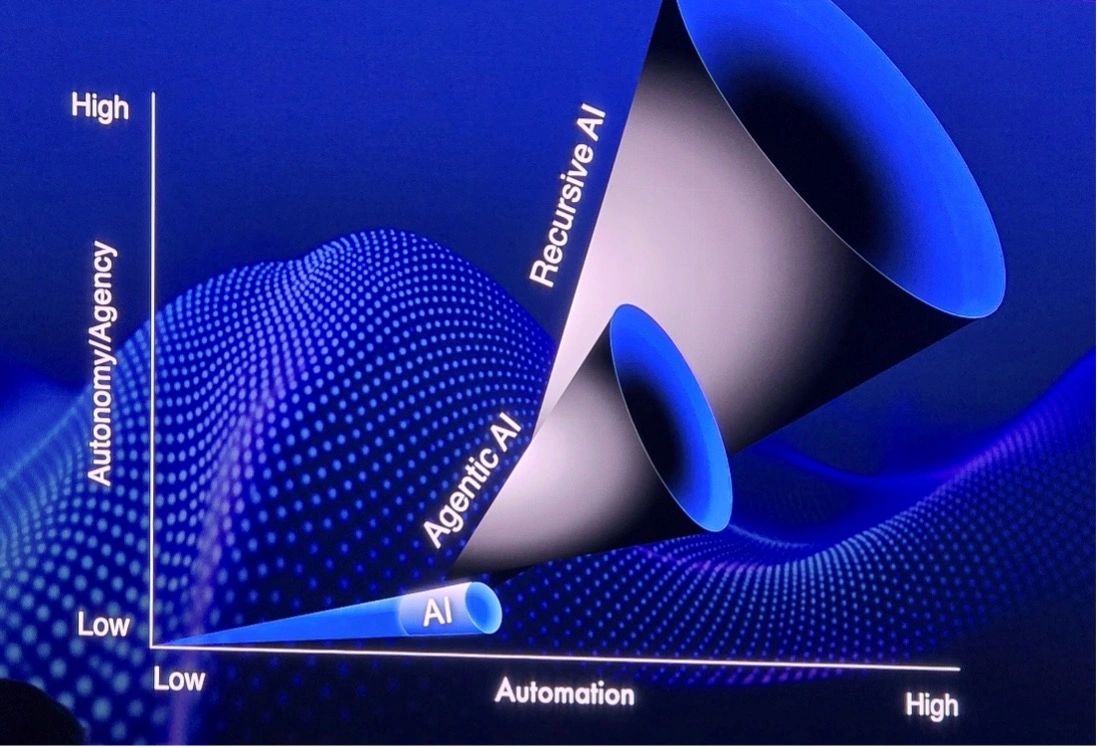
On the automation-to-autonomy curve, most organizations sit squarely in the middle:
· Strong reasoning and self-correction
· Increasing automation
· Deliberately constrained independence
This is not a technology gap. It is a governance decision.
In mission-critical systems, the most serious failures rarely come from a lack of intelligence. They come from ungoverned action.
Why AI Governance Is Obvious in Mission-Critical Environments
That reality was reinforced for me recently at the BICSI Conference, surrounded by professionals who design, build, and operate the physical and digital infrastructure organizations depend on every day.

Nothing in those environments is theoretical. Hospitals, campuses, and public institutions operate under real constraints where redundancy on paper does not guarantee resilience in reality. Systems fail at the seams. Accountability cannot be abstract. Someone must own outcomes.
This is the same reality organizations face when deploying AI into enterprise infrastructure, operational systems, and decision pipelines. As with any critical system, reliability is inseparable from governance, oversight, and accountability.
A Familiar Pattern at Patron Projects
At Patron Projects, this pattern is not new.
Long before AI entered the conversation, we worked in environments where:
· Systems appeared resilient but hid single points of failure
· Vendors optimized for delivery rather than outcomes
· Responsibility was distributed so widely that no one truly owned risk
Healthcare systems, universities, and public institutions do not struggle because they lack technology. They struggle when no one is clearly accountable for how complex systems are planned, integrated, governed, and operated over time.
That is why owner advocacy matters. And it is why disciplines like IT strategic planning, IT infrastructure design, and project governance remain essential, regardless of how advanced the technology becomes.
Agentic AI Will Demand the Same Oversight as Any Critical System
As AI systems move toward greater agency, the core challenge will not be intelligence. It will be controlled:
· Who authorizes action
· Where boundaries are drawn
· How exceptions are handled
· When humans must be involved
· Who is accountable when something fails
These are the same questions we address when overseeing large infrastructure programs, vendor ecosystems, and mission-critical cutovers. Effective IT project management, procurement and vendor governance, and cost-risk analysis exist precisely to prevent unowned decisions from becoming operational failures.
Agentic AI does not eliminate the need for governance. It intensifies it.
Organizations deploying AI into enterprise environments must apply the same discipline used in other high-stakes systems: clear authority models, strong vendor oversight, and structured accountability frameworks.
The Bottom Line
Recursive AI helps organizations think more clearly.
Agentic AI enables systems to act more independently.
But independence without governance is not innovation. It is exposure.
The organizations that succeed with AI will be those that combine advanced capability with disciplined oversight, principled governance, and clear ownership of outcomes. That has always been the role of Patron Projects: ensuring complex systems serve their owners, not the other way around.
AI does not change that responsibility.
It makes it more important than ever.