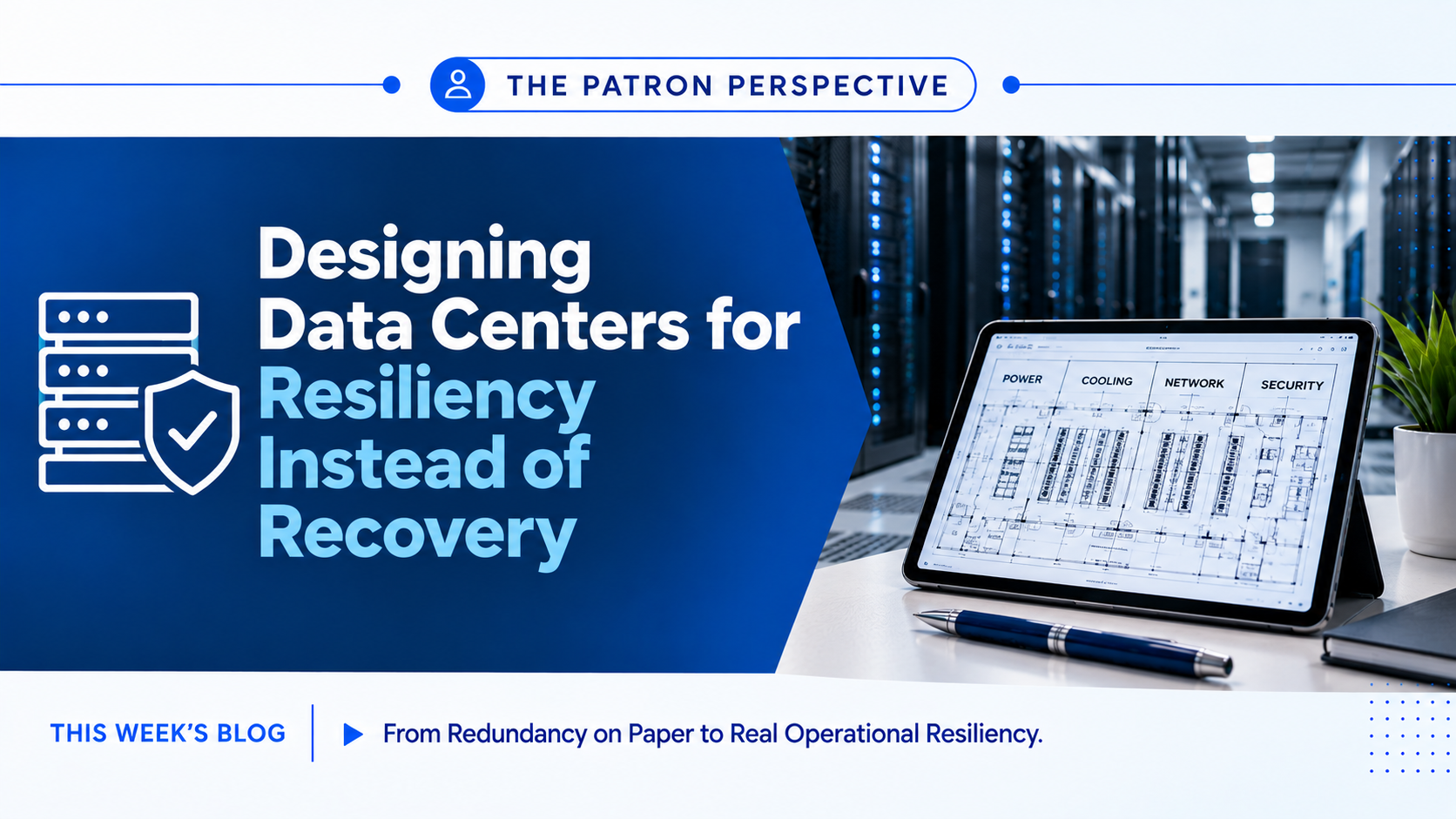
A resilient data center is not defined by how quickly a team can recover after something fails. It is defined by how much of the environment continues operating while the failure is happening.
That distinction matters. Many data centers have backup power, redundant network connections, multiple cooling units, and documented recovery procedures. Those are important protections, but the presence of redundant equipment does not prove that the facility can withstand a real failure.
Resiliency has to be designed and verified as a complete system.
Redundant Equipment Can Still Share the Same Risk
One of the most common problems in infrastructure planning is confusing redundancy with independence.
Two network connections may enter the building through the same pathway. Separate equipment racks may ultimately depend on the same electrical distribution point. Backup systems may rely on controls, cooling, or physical infrastructure that create an unexpected common dependency.
On a diagram, the environment appears redundant. Operationally, one failure can still affect both sides.
These conditions are difficult to identify by reviewing equipment inventories alone. Understanding them requires tracing infrastructure from end to end and identifying where supposedly independent systems converge.
That means looking beyond the data center itself. Electrical distribution, telecommunications pathways, building entrances, cooling systems, fire protection, monitoring, and upstream network connections can all influence whether redundancy actually survives a failure.
Maintenance Is Part of the Resiliency Test
A resilient design also needs to account for planned work.
Equipment eventually requires maintenance, replacement, testing, and upgrades. If servicing one component requires taking down the protection provided by another, the organization may spend significant periods operating without the resiliency it believes it has.
This becomes particularly important in older facilities where infrastructure has evolved over many years. New systems are added, old systems remain in service, and temporary arrangements gradually become permanent. The resulting environment may function normally for years while becoming increasingly difficult to maintain without introducing risk.
Good planning considers the operating state during maintenance, not just normal operation. Teams should understand what remains protected when equipment is offline and whether maintenance creates temporary single points of failure.
Recovery Plans Should Not Compensate for Infrastructure Weakness
Recovery planning remains necessary. Hardware fails. Utility interruptions happen. Construction affects infrastructure. Human mistakes occur.
But recovery procedures should be the final layer of protection, not the primary answer to weaknesses that could have been addressed in the design.
If a single pathway failure can isolate an entire facility, a well-written recovery procedure does not make the pathway resilient. If both sides of a redundant architecture depend on the same upstream component, faster troubleshooting does not remove that dependency.
The stronger approach is to identify these conditions before an outage exposes them.
That requires comparing drawings and documentation against physical conditions, tracing dependencies, reviewing failure scenarios, and understanding how the facility will behave when individual components are unavailable. The exercise often reveals that the most important resiliency improvements are not new equipment purchases. They may involve correcting pathways, separating dependencies, improving documentation, changing operating procedures, or sequencing future upgrades differently.
Design Around the Failure You Want to Contain
A useful resiliency review starts with a simple operational question: what happens when this component is unavailable?
Follow the consequence through the environment. Determine what loses power, connectivity, cooling, monitoring, or physical access. Then determine whether the remaining infrastructure can support operations without relying on the failed component.
This approach changes infrastructure planning from a collection of equipment decisions into a dependency exercise.
It also gives leadership better information. Instead of being told that a system is redundant, decision-makers can understand what failures the environment is designed to tolerate, where exposure remains, and which improvements deserve priority.
That is a much stronger basis for capital planning than waiting for an outage to reveal the answer.
Patron Projects helps institutions assess data center infrastructure, identify hidden dependencies, and manage upgrades with an independent focus on operational risk and long-term reliability.