Higher Education | Healthcare | Government | Enterprise
The decision is bigger than the room
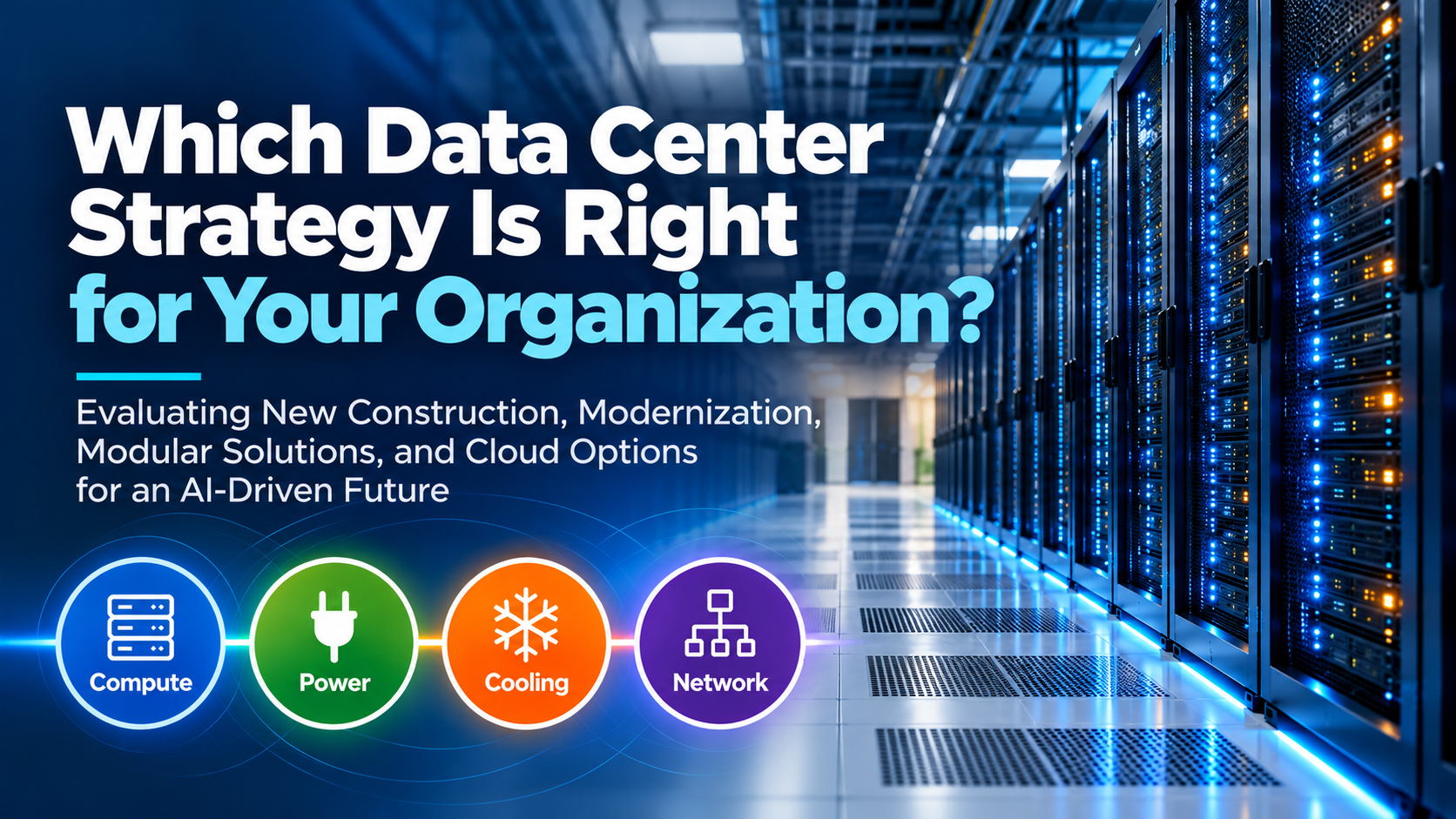
Artificial intelligence is changing the conversation about data centers. Yet the most consequential question for institutional leaders is not how many servers to buy or how large a building should be. It is whether the infrastructure being planned today can safely, affordably, and predictably support the computing demands of the years ahead.
A campus may need AI-enabled research computing. A hospital may expand diagnostic imaging, analytics, and clinical applications. A government agency may need secure, highly available services. An enterprise may consolidate facilities while introducing higher-density workloads. These institutions will not follow identical paths, and they should not be sold identical facilities.
The wrong starting point is a standard configuration followed by a search for a problem it might solve. The better starting point is a clear picture of what the organization runs today, what it expects to run tomorrow, and what failures it cannot afford.
For owners, the biggest risk is not merely building too small. It is building the wrong capacity: spending capital on racks, electrical distribution, or mechanical systems that do not match actual workloads, while leaving expensive constraints elsewhere in the system.
Why the urgency is real
In December 2024, the U.S. Department of Energy reported that data centers accounted for approximately 4.4% of U.S. electricity use in 2023, with a projected 6.7% to 12% by 2028. Those are system-wide forecasts, not a demand forecast for any individual hospital, campus, agency, or business. Their relevance is that power access, equipment lead times, and competing demands are increasingly important to the planning process. 1
Uptime Institute’s 2025 survey likewise describes rising power constraints, costs, and uncertainty around AI demand. The lesson is not to overspend in anticipation of an unknowable future. It is to plan so the facility can adapt as the future becomes clearer. 2
AI changes density more than it changes floor plans
Traditional computing growth was often described in racks, square footage, or server counts. AI and accelerated computing complicate that shorthand. High-performance systems can place substantially more electrical and thermal demand into a relatively small footprint. Two rooms with the same number of racks may have very different power, cooling, networking, and operational requirements. 3
AI is not one workload. Training large models, using pretrained models, research simulations, medical-image analysis, enterprise inference, and everyday applications have different operating patterns. Some belong on premises; others may be better served through cloud or colocation. A future-ready data center strategy starts by distinguishing these needs rather than assuming every AI initiative requires a new high-density facility.
| A practical question to ask If a new AI workload arrives three years from now, what will stop your organization from supporting it first: computing equipment, available electrical capacity, cooling, network pathways, operational staffing, or the ability to add infrastructure without interruption? |
The most expensive mistake is sizing from the wrong assumption
A data center can look half empty and be close to its practical limit. A rack position is not usable capacity unless adequate electrical supply, cooling, connectivity, equipment clearance, and resilience exist to support the workload installed there. Physical space alone is a poor indicator of readiness.
Sizing should begin with an inventory of workload types, actual utilization, peak demand, criticality, growth assumptions, and deployment choices. Then planners can translate plausible scenarios into rack-level and facility-level requirements. The model must include overhead for power distribution, cooling, redundancy, maintenance, and phased operation, without confusing installed capacity with capacity available to IT equipment.
Three futures, not one prediction
A baseline scenario describes reasonably expected growth. An accelerated scenario tests additional AI, research, or mission-critical workloads. A high-density scenario examines what happens if a small portion of the environment needs much more power and cooling per rack. The facility should be evaluated against all three, with explicit triggers for expansion. That is a more responsible basis for capital planning than pretending one ten-year forecast is certain.
Right-sizing also means testing whether every workload belongs in the proposed facility. Strategic use of cloud or colocation may lower the capacity required on premises, but could introduce different connectivity, security, cost, or operational dependencies. The answer depends on the institution, not on a single vendor’s catalog.
The right answer may not be a new data center
Once an organization understands its current infrastructure, future computing requirements, growth expectations, and resilience needs, the next step is to evaluate which data center strategy makes the most operational and financial sense. That decision should not begin with the assumption that a new facility must be built.
- Build a new purpose-designed data center. For organizations with substantial long-term computing demand, specialized equipment requirements, or strict control and resilience objectives, a new facility may deliver the greatest flexibility and long-term value.
- Deploy a modular data center. Prefabricated or modular solutions may be appropriate when capacity must be added incrementally, deployment speed matters, or future growth is uncertain.
- Modernize or transition away from an existing facility. Upgrading power, cooling, connectivity, and supporting infrastructure may extend a facility’s useful life. Where constraints are too severe, relocating or replacing the existing environment may be more sensible.
- Use off-site data center or cloud services. Colocation, managed hosting, or cloud platforms such as Amazon Web Services (AWS) may be better suited to some workloads. A hybrid approach can combine on-premises infrastructure with external services.
Each alternative has different implications for capital investment, operating expense, cybersecurity, compliance, control, connectivity, resilience, scalability, and long-term flexibility. The least expensive option to build is not necessarily the least expensive to operate, and the most sophisticated technical solution is not automatically the best organizational fit.
Patron Projects helps clients compare these alternatives before committing to a direction. With the client’s leadership, IT, facilities, finance, and relevant specialists, Patron can clarify requirements, evaluate realistic paths, and test total costs and risks. The objective is to determine the right data center strategy first, then design, procure, or implement the solution that best supports it.
Security, compliance, and AI governance belong in the evaluation
Cybersecurity is not an optional final check after a data center has been selected. The way an organization protects sensitive information, governs AI applications, maintains service continuity, and meets its obligations can change which infrastructure strategy is appropriate in the first place. These requirements belong alongside workload sizing, resiliency, and lifecycle cost when comparing a new facility, modular deployment, modernization, colocation, cloud, or hybrid solution.
Healthcare organizations may need to address HIPAA and applicable privacy and security obligations; government agencies may face agency-specific policies, NIST-based requirements, CJIS where applicable, and contractual expectations. Requirements vary by institution, workload, location, and service provider. A cloud or colocation option can change who operates certain controls, but it does not transfer all responsibility for access, data protection, governance, or response away from the organization.
AI introduces another layer of questions: Which tools and models are in use? What data is being submitted or retained? Where do information and outputs travel? Who approves AI use cases, monitors third-party dependencies, and manages new risks? The NIST Cybersecurity Framework 2.0 and AI Risk Management Framework can help structure a coordinated review of enterprise controls and AI-specific risks when relevant to the client.
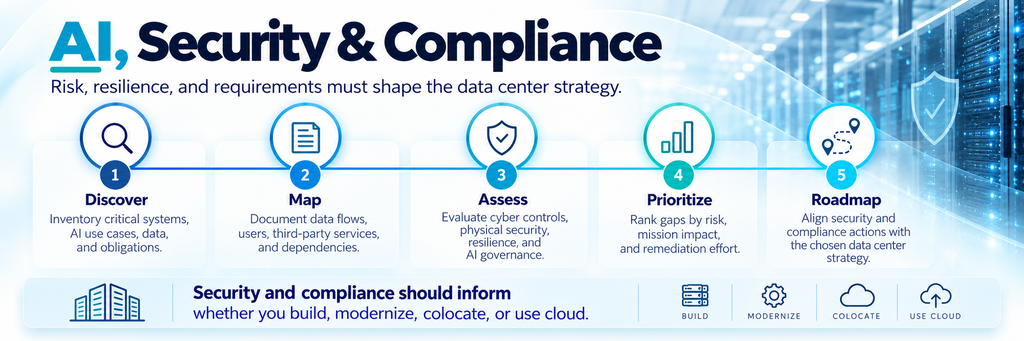
A practical evaluation can follow five connected steps: Discover critical systems, AI use cases, sensitive data, and obligations; Map users, data flows, infrastructure, and outside providers; Assess cyber safeguards, physical protection, operational resilience, and AI governance; Prioritize gaps by likelihood, mission impact, and remediation effort; and build a Roadmap aligned with the selected data center strategy. The purpose is not to prescribe the same controls to every client, but to make security and compliance requirements visible before major decisions are locked in.
Power: a data center’s actual growth boundary
Electrical readiness is a chain, not a number on a utility bill. Available utility service, service entrance, switchgear, transformers, uninterruptible power systems, generators, branch distribution, rack feeds, and the maintenance strategy all affect what can be supported reliably.
A proposed electrical system may have attractive nameplate ratings yet have less usable IT capacity after considering redundancy, fault tolerance, existing loads, thermal limits, and maintenance conditions. Designers must also evaluate how growth affects protective coordination, equipment replacement windows, utility lead times, and failure response. Buying additional servers is usually easier than creating new electrical capacity.
Future-proof the pathway, not just the equipment
Sometimes the best investment is an expandable electrical architecture: reserved physical space, distribution routes, conduit pathways, and defined capacity-addition points. These provisions can be less disruptive to establish at the beginning than to retrofit inside an operating mission-critical facility. The correct amount varies by site and should follow a documented lifecycle and cost analysis. 3
Cooling: the other half of the capacity equation
Nearly all electricity consumed by IT equipment ultimately becomes heat that must be managed. As loads become more concentrated, the question changes from whether a room is air-conditioned to how effectively heat is collected, transported, and rejected in normal and failure conditions.
Traditional air systems remain practical for many environments. Higher-density installations may require containment, rear-door heat exchangers, direct-to-chip liquid cooling, or mixed systems. Liquid cooling should not be specified simply because AI is mentioned. It should be considered when workload density, equipment requirements, site conditions, resilience, and operating economics justify it. 4
The design should address not only cooling equipment but also piping routes, water and leak-management considerations, service access, controls, residual air-cooling needs, backup capacity, and ongoing maintainability. A technically efficient system that the operating team cannot safely maintain is not future-ready. 4
Room-average temperatures can conceal hot spots at individual rack inlets. Evaluate mixed-density zones, peak outdoor conditions, water availability, and performance before the facility reaches full load. Cooling should work efficiently during each growth phase, not only at its final design point. 4
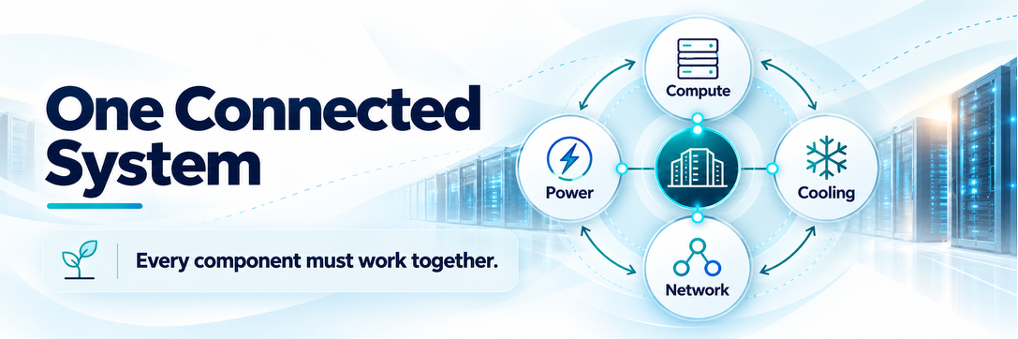
Power and cooling must be sized together
A high-density expansion that fits within the electrical plan may exceed the cooling plan. A cooling upgrade may require more electrical capacity. Both systems may share failure modes. These questions must be resolved as one engineering problem, not as separate mechanical and electrical purchases. 3
Resilience is designed from the end user back
Redundancy is not the same as resiliency. Duplicate components can still depend on one utility connection, one equipment room, one network pathway, one control system, or one maintenance procedure. Those dependencies become apparent only when the entire service path is studied.
For a hospital, loss of service can affect clinical operations. For government, it can interrupt essential public services. For higher education, it can disrupt teaching, research, and campus operations. For enterprise, it can stop revenue-generating work. The required degree of resilience should reflect actual consequences of failure, recovery objectives, and operating capabilities.
The owner should be able to follow a critical service from the user’s device or application through the campus or enterprise network, transport infrastructure, data center connectivity, compute, power, and cooling. That is where hidden single points of failure are found. Every supposedly independent path should be examined for shared physical and operational dependencies.
For example, two network carriers do not create true route diversity when both fibers share the same trench or building entrance. Physical pathways should be verified, not assumed from logical network diagrams.
Prove resilience before accepting the facility
Commissioning is the structured process of verifying that the installed systems meet the owner’s requirements. Define acceptance criteria during design, then test representative loads, planned maintenance conditions, and agreed failure scenarios under controlled procedures. Verify that power, cooling, controls, and alarms respond together, not just that each component turns on. 5
Operating readiness also requires current documentation, monitoring, trained staff, and workable response procedures. Physical and cyber access controls should support secure recovery and safe maintenance. A resilient design must be matched by an operating team that can sustain it. 5
Two connected projects, one accountable owner advocate
The strongest data center projects do not treat outside infrastructure and the facility itself as separate worlds. The institution benefits from one coordinated strategy that connects end-user service requirements to the final facility design.
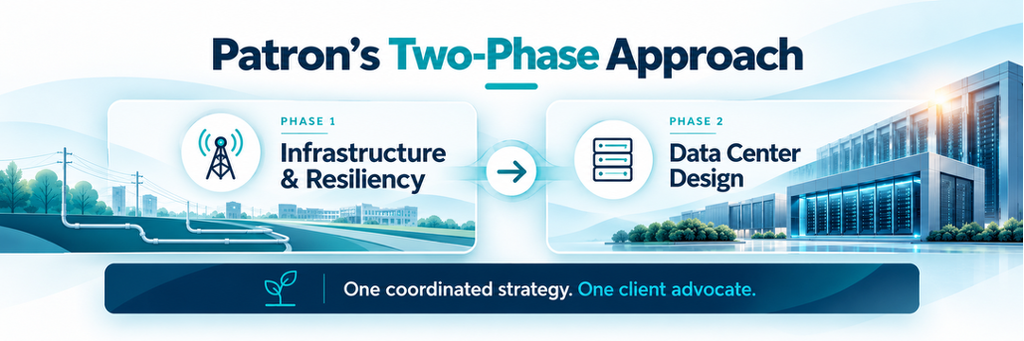
Phase 1 | The infrastructure that makes the data center useful
Patron Projects begins with existing-condition verification and the infrastructure surrounding the facility. This may include site mapping, fiber routes and diversity, copper where required, inter-building connectivity, network and telecommunications spaces, critical pathway verification, budgets and phasing, and the interfaces between established systems and the future data center.
Where telephone, public-safety communications, or related systems are affected, the assessment also considers applicable E911 dependencies and continuity requirements. Not every project needs a new E911 design, and copper is not a universal requirement. Their inclusion must be driven by actual legacy systems and operational needs.
The result is a grounded understanding of what the data center needs from the broader institution and what the institution must change to use the facility as intended.
Phase 2 | A data center designed around the organization
With requirements established, Patron coordinates specialized data center engineering and design support directly with the client’s IT and facilities teams. The work can evaluate current loads, growth scenarios, electrical and mechanical systems, thermal strategies, resilience objectives, facility configuration, modular expansion, commissioning, and operating constraints.
The objective is a customized, manufacturer-neutral basis of design, not a preferred product selected in advance. Well-developed requirements can then inform a competitive request for proposals (RFP) to qualified providers. Comparable scope, transparent assumptions, lifecycle costs, and clear evaluation criteria help the owner see what is actually being purchased.
Put the actual build and implementation out to bid
The RFP should cover the actual creation of the data center, not simply a list of equipment. Depending on the delivery approach, qualified contractors, manufacturers, and systems integrators should price clearly assigned scopes for equipment supply, electrical and cooling work, installation, integration, migration, commissioning, training, and documentation. The process should follow the institution’s procurement requirements.
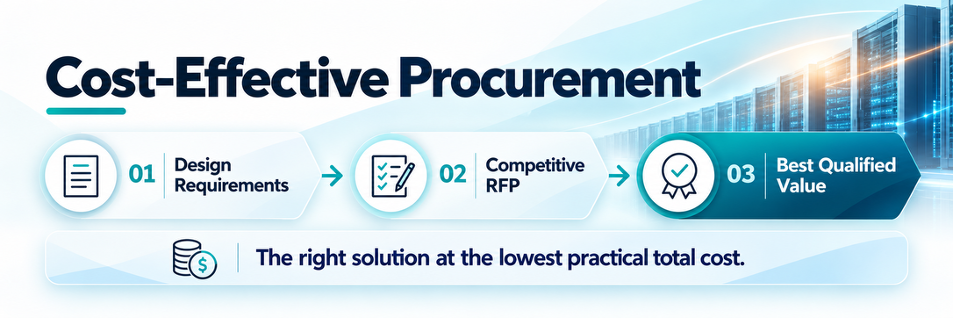
Patron’s owner-advocate approach is manufacturer-neutral and contractor-agnostic: the client’s requirements guide the selection, rather than a commitment to a particular product or installer. Neutral procurement still requires qualified providers, compatible systems, clear responsibilities, and verifiable performance. Alternatives can be considered, but their deviations and tradeoffs should be explicit.
Use a common bid schedule and evaluation criteria so exclusions, allowances, schedule assumptions, warranties, and service obligations are visible. Compare total installed cost and credible lifecycle costs, including energy, maintenance, support, and future expansion. The objective is the right technical solution from a qualified delivery team at the lowest practical total cost, not an attractive opening price followed by avoidable change orders.
Competitive bidding is not a guarantee of a particular savings percentage. It is a disciplined way to test cost, design alternatives, commercial terms, schedule, maintainability, and risk. The lowest bid may not provide the best total value, particularly if it hides exclusions or creates additional long-term operating costs.
The difference between a proposal and a defensible decision
Organizations often receive a data center proposal before their requirements are fully understood. At that point, it is difficult to tell whether an estimate reflects their actual needs or the assumptions of the proposed manufacturer. A facility design and procurement process should make those assumptions visible before the organization commits millions of dollars.
The right process challenges initial cost expectations, tests different approaches, and compares like-for-like bids. In some projects, sharper requirements and competition uncover substantial cost avoidance. In others, engineering reveals necessary investments that were missing from the first estimate. Both outcomes protect the owner from a decision based on incomplete information.
Affordability starts with the design
Cost control begins before the RFP. Test whether serviceable infrastructure can be retained, whether modernization or phased construction can meet the need, and which investments can wait for verified demand. Compare those options against a new facility on the same service requirements, including remaining equipment life, disruption, migration, operating cost, and expansion constraints. Reuse is not automatically cheaper, and new construction is not automatically better.
What future-proofing really buys
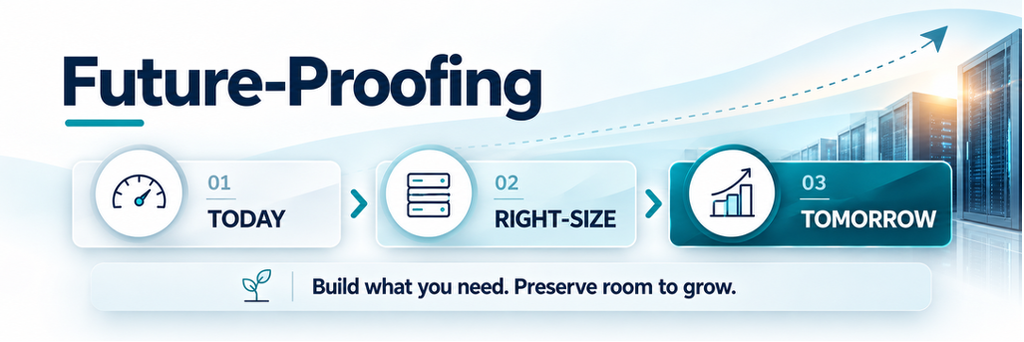
It does not mean installing every possible technology or paying now for all conceivable growth. It means selecting a sensible initial capacity, preserving realistic expansion paths, minimizing irreversible constraints, and defining the conditions under which new infrastructure should be added. Flexibility is valuable only when it is both technically feasible and financially justified.
Before approving the next project, ask these questions
- What are our verified current workloads, utilization patterns, and critical services?
- Which future AI uses are probable, which are speculative, and where should they run?
- What constrains expansion first: power, cooling, pathways, network, space, or operations?
- How much IT capacity will actually be usable after redundancy and maintenance requirements?
- Have we tested the end-to-end service path for shared points of failure?
- Which design decisions should be made now, and which can be deferred until demand appears?
- Have IT, facilities, security, operations, finance, and procurement aligned on requirements?
- Will manufacturers, contractors, and integrators bid against the same independently established requirements, with clear inclusions, exclusions, and acceptance criteria?
- How will commissioning prove performance during realistic failures?
- Who is representing the owner’s interests from site infrastructure through facility acceptance?
Start with the requirements, not the equipment
A future-ready data center is neither the biggest nor the most expensive option. It is the one that meets the organization’s requirements today, can expand along credible pathways, and continues to deliver its critical services when conditions change.
Patron Projects helps institutions begin with the right questions. As an independent owner advocate, Patron brings together infrastructure assessments, site and network planning, client requirements, specialized engineering design support, competitive procurement, and program oversight. The approach keeps decisions tied to the institution’s interests rather than a manufacturer’s standard configuration.
An initial discussion should clarify current limitations, known reliability concerns, likely workload changes, and upcoming capital decisions. From there, Patron can help define a readiness evaluation: verified existing conditions, capacity and dependency risks, practical improvement options, and priorities for further design or procurement. The first step is understanding the decision, not committing to a new facility.
Whether the best solution is a new facility, modular deployment, modernization or relocation of an existing data center, colocation, cloud services, or a hybrid approach, Patron’s role is to help clients make that decision with confidence. Our process begins with an objective evaluation of business requirements, infrastructure readiness, lifecycle costs, operational risks, and future growth. We help establish the right direction before significant capital is committed to any particular solution.
Cybersecurity, regulatory compliance, and AI governance are also part of that discussion. Patron helps bring the appropriate security and technical specialists into a coordinated evaluation so the recommendation reflects not only infrastructure performance and cost, but also the organization’s risk and compliance priorities.
Whether your organization is considering a new data center, modernizing an existing one, or planning for future AI workloads, start with a Data Center Readiness Discussion. Patron can help establish what you have, what you will need, and how to make the next investment defensible.
| Schedule a Data Center Readiness Discussion Know what you can support. Understand what could fail. Invest with a plan. |
Call 909.300.5809 | info@patronprojects.com | www.patronprojects.com
Sources and further reading
2. Uptime Institute. Global Data Center Survey 2025. July 29, 2025.